Pre-Topic Testing – My Approach
As maths teachers, we are always on the lookout for strategies that can support our students’ reach their full potential. In January, I started looking into lesson planning and designing tasks when I stumbled upon the pre-testing effect through an insightful article – https://files.eric.ed.gov/fulltext/EJ1052549.pdf. The research discussed how pre-testing students before introducing them to a new topic could improve their learning outcomes. I was intrigued by this idea so, I decided to try this with my Year 10 class.
Background Of My Year 10 Class
My Year 10 class comprised of students with a good understanding of mathematical concepts. However, a lack of confidence was holding them back from realising their full potential. Despite their efforts and great class work, their end-of-term assessments didn’t reflect their true capabilities. I was convinced that these students were capable of higher-tier GCSE work, but they were finding it a challenge to step beyond foundation-level knowledge without constant reassurance.
The Pre-Topic Testing Strategy
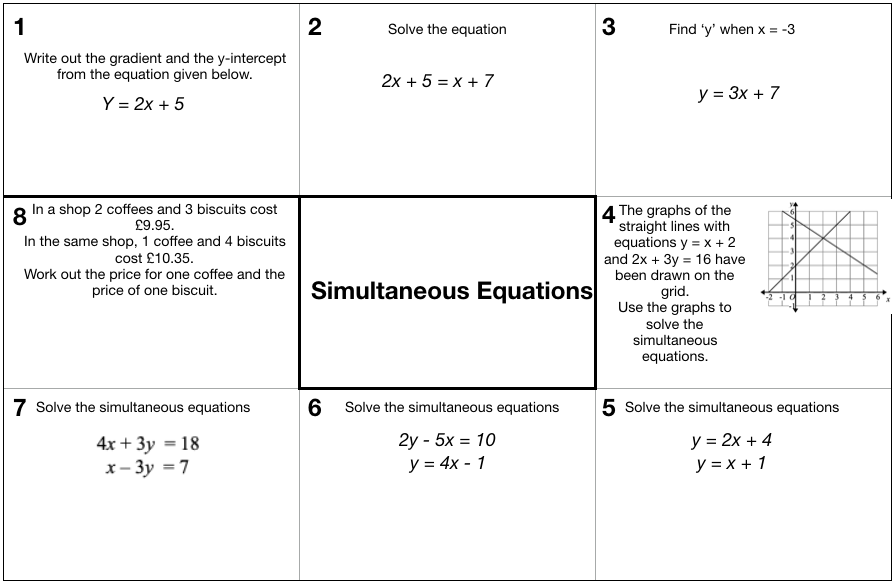
Above is an example of one of my pre-topic tests which was inspired by Nathan Day’s ‘snake’ resources on www.interwovenmaths.com, I developed a pre-topic testing strategy tailored to my class’s needs. Each pre-topic test comprised of eight questions, designed to assess different aspects of the upcoming topic:
- Questions 1 & 2: These covered prerequisite knowledge, ensuring students had the foundational understanding needed to tackle the topic.
- Questions 3 to 6: These questions aligned with the specific content I planned to teach, providing a clear benchmark for students’ understanding at the outset.
- Questions 7 & 8: These were challenge questions, intended to stretch students’ thinking and push the boundaries of what they would learn.
Measuring Progress
To gauge the effectiveness of this approach, I implemented a simple yet effective assessment method. At the start of each topic, students took a pre-topic test. Their responses were marked and recorded, but the results were not shared with the students immediately. This allowed me to keep track of their initial understanding without influencing their confidence or expectations.
At the end of the topic, students took the same test again. This repetitive testing was designed to measure their progress objectively. The rationale was straightforward: if students had fully grasped the material, they should replicate or improve on their initial scores.
Interesting Insights
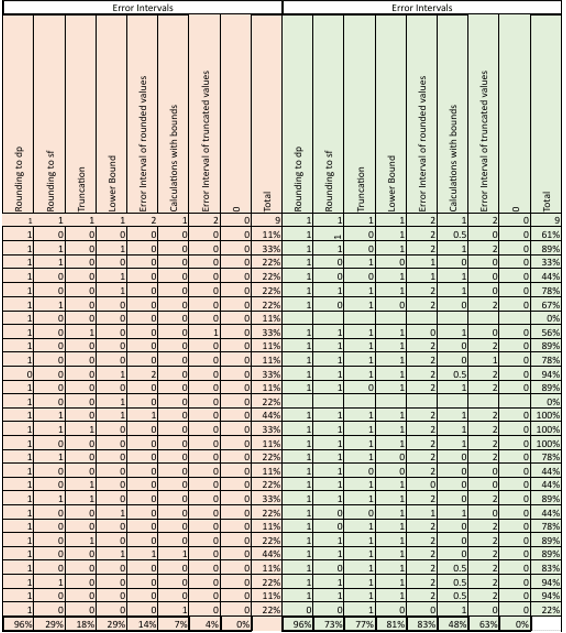
In the first round of pre-topic and end-of-topic tests focused on error intervals and bounds, the results were quite revealing. On the left side of the spreadsheet pictured above is the PTC (pre-topic check) data, while the right side shows the ETC (end-of-topic check) results. After marking the second tests, I paired each student’s initial and final tests and handed them back with only the marks visibly displayed on the front—no comments. As per my usual practice, I distributed these assessments face down on their desks, instructing students to wait until everyone received their papers before turning them over. This ensured a simultaneous and uniform reveal of their progress.
The ensuing discussions among the students were enlightening. The first question that popped up was, “What did you get on the first one?” Interestingly, despite their initial scores being on the lower side, the atmosphere was surprisingly upbeat. They were visibly pleased to observe the progress they had achieved.
Another conversation I overheard was, “How did I get that one wrong when I got it right the first time?” Watching them collaborate with their partners to identify and understand their errors was a fantastic display of self-correction and critical thinking.
At the end of the term, I asked the students for their feedback on the pre-topic and end-of-topic testing approach. The unanimous response was overwhelmingly positive, with all the students expressing their appreciation for the method and their desire to continue using it in the following term.
The Outcome
This approach not only provided a clear measure of students’ progress but also fostered a growth mindset. Students began to appreciate the value of effort and the importance of persistence. The pre-topic tests acted as a diagnostic tool, helping me tailor my teaching to address specific gaps in knowledge and understanding.
Incorporating pre-topic testing has been a game-changer for my Year 10 class. By setting clear expectations and systematically measuring progress, we’ve seen a significant boost in both confidence and achievement. For those considering this approach, I highly recommend giving it a try. You might be surprised by the positive impact it can have on your students’ learning journey.
Next Steps
Next year, I plan to implement the pre-topic and end-of-topic tests with another of my classes to determine if the results can be replicated. My goal is to boost my students confidence by helping them recognise their progress between the start and end of teaching a topic, showing them that their efforts truly make a difference.
 Michelle's Teaching Insights
Leave a comment